Portland Homeless Crisis
Statistics -- Portland Oregon
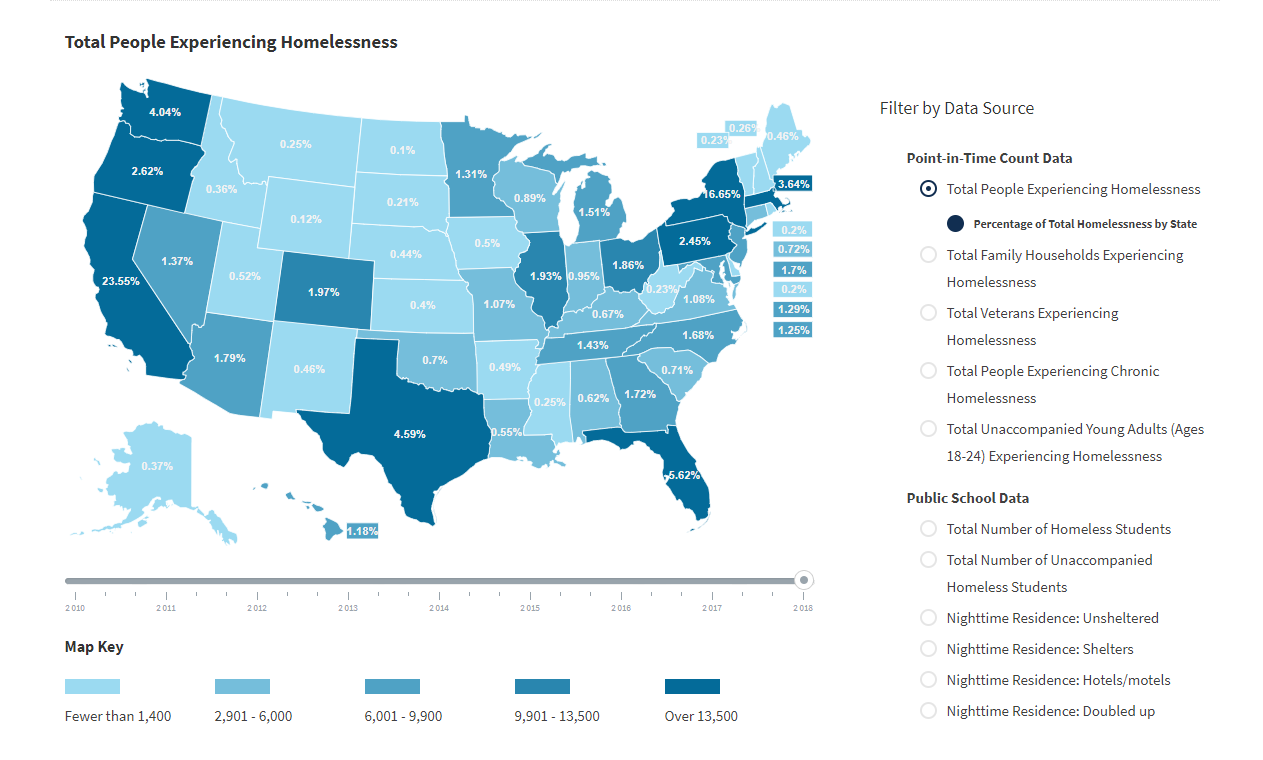
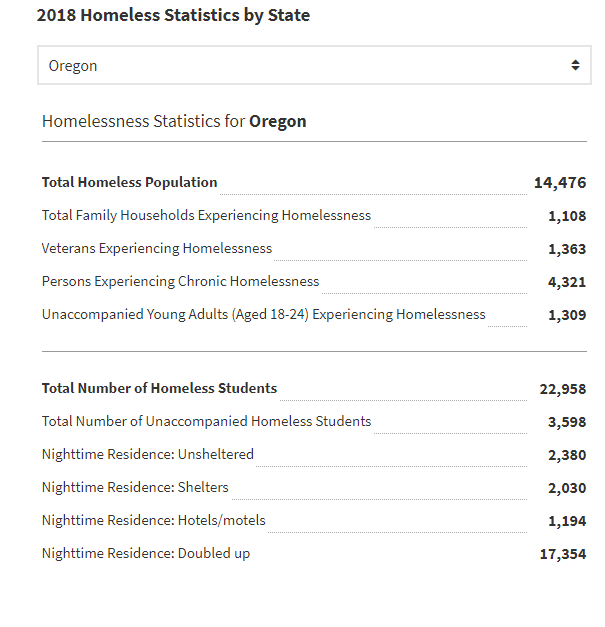
As of January 2018, Oregon had an estimated 14,476 experiencing homelessness on any given day, as reported by Continuums of Care to the U.S. Department of Housing and Urban Development (HUD). Of that Total, 1,108 were family households, 1,363 were Veterans, 1,309 were unaccompanied young adults (aged 18-24), and 4,321 were individuals experiencing chronic homelessness.
Public school data reported to the U.S. Department of Education during the 2016-2017 school year shows that an estimated 22,958 public school students experienced homelessness over the course of the year. Of that total, 2,380 students were unsheltered, 2,030 were in shelters, 1,194 were in hotels/motels, and 17,354 were doubled up.
-
Supportive housing: Portland and Multnomah County are moving toward their goal of creating 2,000 new affordable and services-connected apartments by 2028. More than 600 units are in place or in development. The number of unsheltered people who reported a substance use disorder increased by 303 in this year’s count. People in treatment who also have housing are 10 times more likely to succeed in their treatment than those without housing.
-
Rent assistance: The Joint Office is making historic targeted investments to help chronically homeless people move through shelters and back into appropriate housing more quickly.
-
Hygiene amenities: Portland is investing in hygiene facilities and trash collection to help people address the consequences of having to live their private lives in public.
-
Downtown behavioral health center: Multnomah County’s behavioral health resource center — offering peer-run services, a day center, and shelter and transitional housing — is out for bid and could open by summer 2021.
-
Evolving shelter system: Two new services-enhanced, navigation focused emergency shelters are set to open this summer: the River District Navigation Center in the Pearl District and the Laurelwood Center on SE Foster Road.
-
Specialized outreach: The Navigation Team launched this spring. It brings intensive engagement, service connections and mental health expertise to the highest-impact encampments.
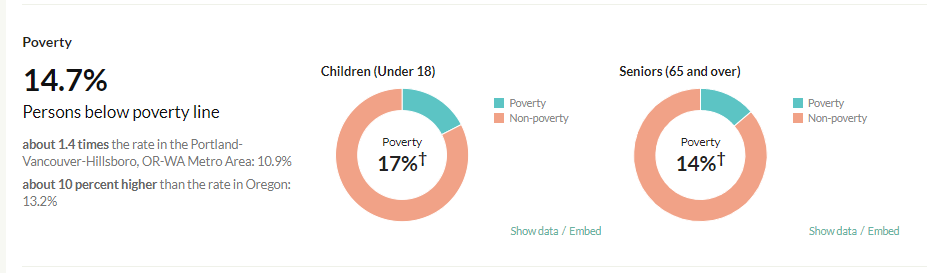
- In Multnomah County, more than 21,000 disabled people rely on federal Supplemental Security Income benefits that top out at $771 a month. The average rent for a one-bedroom apartment, meanwhile, has climbed to $1,200 in Multnomah County.
- Even people working full-time jobs are at risk. Last fall, consulting firm ECONorthwest found some 56,000 low-income households across the metro region who pay so much for housing — more than half their income — they could land on our streets on any given night.
Interviews
Danis Garcia - Interview
I do some of my shopping at Target. For the last couple days my group has been pondering about homeless life. Not a revealing subject because I see them all over Portland, some places are more obvious than others, for example, supermarkets, parks, and train stations. I decided to go for a walk for two reasons, one, buy some groceries, two hoping to talk to a homeless person. A 59-years old female from Wisconsin---her name is Mary. The first question I asked was “Do you consider yourself homeless?” “No, I have a room and I pay $500 a month” she replied. I paused for a second and I thought if it was worthwhile to interview her because literally her answer disqualified her from my research---what is the homeless life is like. I have seen this person several times for the last couple weeks, I was pretty sure she was new to the area. I thought for a second about what the word “homeless” would mean to her. Suddenly “homeless” was like a dirty word. A label, laden with negative stereotypes that strip peoples’ dignity away. I sat on the curb next to her as I decided that it was worthwhile to take notes about her story.
I asked Mary if I could take audio-record our conversation, but she declined to accept. She said that we could have a conversation and that she thought I could remember the details afterward or take notes. I was surprised to be told by her that she was not a drug user without me asking her. “I am honest person” she affirmed when I asked her, “What do you think society thinks about you?” then Mary continued, “I don’t exist. I am invisible. You can have 50 people passing by and they will not look at me. I am an honest person. I don’t use drugs. I moved her 6 months ago. This place (pointing to the block where she was seated and asking for alms) is a drug corridor. If I sit here, people think I am using drugs.” Mary has no family except for her elderly father. When I asked her, what was the most difficult thing living in Portland. She told me that Portland is expensive, “I pay $500 for a room with no bathroom or shower.” The money she receives every month is from the Social Security, but it is not enough so she has to beg money to subsist. She doesn’t feel threatened by homeless people. Even though she is a senior female. If there are people already on that corner, she just moves to another corner where she can do her job. I asked “What scares you the most in life?” She said, “I am scared of getting Alzheimer’s. My mother was 65 when she got it, she spent her last 10 years in a nursing home. She didn’t remember me. I am scare of getting Alzheimer’s.”
Interview - recording 1 - 3
Interview - recording 2 - 3
Interview - recording 3 - 3
Danis Garcia, Interview
King Jesus Church is across the road from Shelter California (now closed). During my one of my strolls through the areas, I was invited to attend the Sunday’s service from a couple I interviewed afterward. I agreed to go if they let me interview them about the church and their life. I would have never known that that building was a church. On the corner, there is a bus stop often frequented by homeless people. The area’s sidewalk is often dirty, with cigarettes butts, chewing gums and rubbish left behind by homeless people. I was dumbfounded about that place, not what I had in mind when I thought about a church. Of course, I had seen that building before; behind used to be the Paris Theatre and on the other side of the block is the infamous Voodoo Donuts. I had walked by it several times when I would go to a restaurant over ChinaTown. In the past, I remember taking the bus from there and I began wondering who in the world would attend a church like that? I could feel myself rolling my eyes and feeling stupid. But that moment was an epiphany. I could see, Shelter California across the street used to serve women; across the street a mission providing meals and a place to stay during winter days. In front, opposite King Jesus Church there is a homeless shelter and two blocks away down the street there is another church and shelter. Bingo, this is the geography of inequality---everything started making sense. That explained the presence of homeless people in the area and the drug reputation that I heard of.
Inside King Jesus Church, there were about 30 people. Few had backpacks or bags indicating they were homeless. Coffee and doughnuts are served. The rest of the congregation was dressed modestly for the morning sermon. The place is about 40x40ft with a backdoor to the kitchen and bathroom behind the pulpit. The locale is very modest. It is like walking into a restaurant with rounded tables and chairs, if not for the pulpit in one corner, I would swear has the layout of a restaurant. A big wooden Protestant cross dominated the scene. Banners carrying messages of hope, love, and faith hung down from the walls and pillars. I stood by the entrance as I assessed the area. A big man with a million-dollar smile greeted me and said: “God Bless You”. I replied with a happy smiling “thank you”.
Before having a seat, I walked and turned left where they were serving donuts and coffee. Just about to join the queue, I saw Robert. I talked to him for a few minutes then I proceed to get a coffee. Then I sat and to observed the people. I felt uncomfortable because I am not interested to know about Jesus his superhero stories and I sensed that people thought I was there because of Jesus. I asked a man seated at the next table about charity programs, services, and hours. I was aware of it, but I needed to know the opinion of someone who was directly involved in it. I did not ask permission or consent to the church nor I told them about my project except for Robert and Cathy. I was invited by Robert and his wife and they knew about my project because we made a deal. During my time at the church, I briefly talked to one person, the rest of my time I just observed people. Because of my questions, this person thought I was homeless. He asked me if I needed a hoody, food or shelter. I replied, “no, maybe next time”. He said to me, “this church is poor. They don’t serve food, but they can give you a hoody or jacket to keep yourself warm.” Today at 2 pm they will be serving food under the bridge. Do you want a bag of bread? Thursday nights, they feed the homeless. If you want food, you should come on Thursday at 7 pm under the Hawthorn bridge.”
I was very pleased to hear that, I felt that he was caring about me. I could sense a kind of brotherhood among them. I deduced that most of them were ex-homeless and that they emphasize with people looking for help.
Do I look like homeless I asked myself? I have nicely dressed in comparison to them---a very immodest observation about myself. Then, I felt a bit odd. I was dressed casually, like if I were to go to class, but in this case, it seems too nice to be dressed that way. The congregation was a mix of colours and faces. Few minutes before the service started, a young good-looking and healthy man entered. He was dressed elegantly in a tuxedo and shining shoes, necktie and nice trousers and a long-sleeve shirt. I had a difficult time finding out about this individual. It made no sense to me; he did not seem homeless. I thought for a second whether he was a researcher or perhaps he simply too dressed up for the occasion. The more I noticed him, he appeared troubled especially during the sermon. I deduced that he was an ex-homeless man who had been incorporated back into society and was doing well. But he would come to King Jesus Church to feed his spirituality. He was not a stranger; I saw him talking to other members and being acquainted with the building. I have been many times at an Anglican cathedral in Portland, and the sermon preached at that church is relevant to the congregation’s demographics and status. I can describe the Anglican congregation as white, middle to the upper class. For example, they travel to London and other places inside and outside the U.S. as part of their chorus programme. Their kids participate in hiking trips and mission of evangelism in developing countries. They often gather for drinks and party after mass. This is a huge disparity in ideology. The sermon preached at King Jesus was about detachment from worldly desires such as wealth, leisure and pleasure---nothing like I have ever heard at the Anglican cathedral. At the King Jesus Church, all problems have one solution---Jesus.
I met Robert and Cathy. They were friendly, so I began asking questions about the people in the shelters. They thought I was homeless or I was looking for help. I told them my purpose and intentions and they were excited to help. Robert and Cathy are in their 60’s. They have been together for 43 years. Cathy was 17 when she ran away from home because she could not put up with her father’s dicta. She was headstrong. On the other hand, Robert comes from a dysfunctional family. When Cathy ran away, she encountered all sorts of challenges and novelties. She was drawn into drugs. “I was in North Portland looking for cocaine. There I met Robert and he offered himself to take me to a dealer. Since then we’ve been together. We spent sometimes living in Portland, but then, we went to Las Vegas. We needed $300 a day to maintain our habits. Sometimes we slept in motels, sometimes on the street. Mum did not know about me for a long time.” My interview with Robert and Cathy did not turn as I expected. I interviewed them together. When I asked the questions, Robert provided more information that I expected or Cathy would disagree but eventually agree with him. For example, when I asked if they had been homeless, Robert said “yes” but Cathy said “no”. “Well, we were not really totally homeless. we slept many times under bridges or on the street., but it was convenient for us to stay in town.” “Sometimes we could not go home and we had to stay in town” added Robert.
In addition to drugs, Robert and Cathy got into trouble with the law. As a result, Robert incriminated himself to free Cathy from going to jail. He went to jail several times. His last time in jail; he “met Jesus” about seven years ago. They are members of King Jesus’ congregation, and their drug life is buried in the past. They are not homeless. As gratitude, they both attend church and help homeless people by volunteering and testifying how Jesus changed their lives. I had to cut short my interview because Cathy was feeling uncomfortable. She did not tell me that, but I noticed it. Often, she contradicted Robert then gave in. As a result, I was not able to get all the information I wanted.